
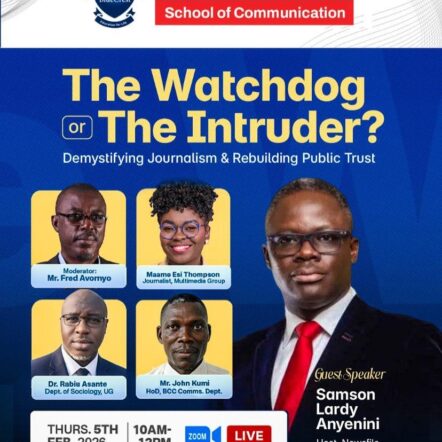
THE WATCHDOG OR THE INTRUDER? DEMYSTIFYING JOURNALISM AND REBUILDING PUBLIC TRUST
In an era where journalists increasingly face hostility, mistrust, and even physical attacks, the BlueCrest College School of Communication organized a timely and thought-provoking webinar titled “The Watchdog or the Intruder? Demystifying Journalism & Rebuilding Public Trust.” The virtual event brought together seasoned media professionals and academics to interrogate the role of journalism in modern society and address the growing tension between journalists and the public.
The webinar, moderated by Mr. Fred Avornyo, featured insightful contributions from Maame Esi Thompson (Journalist, Multimedia Group), Dr. Rabiu Asante (Department of Sociology, University of Ghana), Mr. John Kumi (Head of Department, BCC Communications), and Samson Lardy Anyenini (Host, Newsfile – Multimedia), who served as the guest speaker.
The Head of Department, BCC Communications started with a welcome address, in his welcome address, Mr. John Kumi described the webinar’s theme as timely and essential to democratic society. He noted that journalism today operates in a highly visible yet contested space, where the media is expected to hold power accountable while frequently being accused of intrusion, bias, and sensationalism.
He explained that the webinar was created as a professional and safe platform to ask difficult questions, challenge assumptions, and rebuild trust between journalists, institutions, and the public. Mr. Kumi emphasized that journalism must be grounded not only in practical skills but also in ethics, law, sociology, and social responsibility, which informed the multidisciplinary composition of the panel.
He further highlighted the importance of dialogue between the media and security institutions, noting that cooperation between both sides is vital for public safety and national cohesion. Addressing students and prospective participants, he stated that the webinar reflects BlueCrest College’s commitment to practical, responsible, and real-world communication training. He concluded by encouraging active and respectful participation and expressed confidence in the value of the discussion
A key message emphasized throughout the discussion was the true role of journalism. Journalists are often misunderstood as gossipers or intruders; however, journalism is rooted in truth, accuracy, and facts. The profession exists to educate, inform, and hold power accountable.
Maame Esi Thompson shared experiences of verbal attacks and noted that many journalists face physical assaults. These attacks persist largely due to the lack of effective punishment for perpetrators, encouraging repeated offenses.
 Maame Esi Thompson
Dr. Rabiu Asante explained that abuse of power often stems from societal conditioning where authority is used to instill fear. This mindset carries into public office and negatively affects journalists.
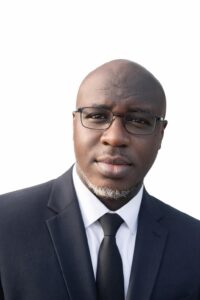 Dr. Rabiu Asante
The panel stressed that no story is worth a journalist’s life. Journalists must prioritize safety and adhere strictly to ethics such as truth, accuracy, and factual reporting.
Samson Lardy Anyenini made reference to Article 162 of the 1992 Constitution of Ghana, which guarantees freedom and independence of the media. Article 18(2) was also discussed regarding privacy and disclosure. SLAPP and Anti-SLAPP legislation were highlighted as key legal issues affecting press freedom. Rebuilding trust requires ethical journalism and public understanding of the media’s watchdog role.
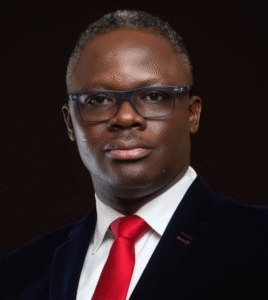 Samson Lardy Anyenini